




SPECIAL INTEREST
Footsteps of Heroes (B) 12 days
Tour Highlights
- The War Memorial of Korea
- Gyeongbokgung Palace
- National Folk Museum of Korea
- Insadong
- Namdaemun Market
- Incheon Landing Sites
- The 3rd Tunnel
- Gapyeong Memorial Monument
- Yanggu War Memorial
- Punchbowl Battlefield
- The 4th Tunnel
- Eulji Observatory
- The Peace Dam
- The 2nd Tunnel
- Baekmagoji HIll
- Labor Party Office Building
- Hwaseong Fortress
- Jukmiryong Battlefield
- Dabu Wam Memorial
- Hill 303
- Bulguksa temple
- Seokguram grotto
- Gyeongju National Museum
- Tumuli Park
- UN Memorial Cemetery
- Gamcheon culture village
- Jagalchi fish market
Click on the days to access the programs quick
| Days | Visits and Activities | Distance |
| Day 1 | Arrive Seoul | 60km |
| Day 2 | Seoul | |
| Day 3 | Seoul - Incheon - Seoul | 100km |
| Day 4 | Seoul - DMZ - Seoul | 140km |
| Day 5 | Seoul - Gapyeong - Punchbowl - Yanggu | 230km |
| Day 6 | Yanggu - Hwacheon - Cheorwon | 120km |
| Day 7 | Cheorwon - Suwon | 140km |
| Day 8 | Suwon - Osan - Dabudong - Chilgok - Gyeongju | 360km |
| Day 9 | Gyoengju | |
| Day 10 | Gyeongju - Busan | 110km |
| Day 11 | Busan - Seoul | 450km |
| Day 12 | Departure | 60km |
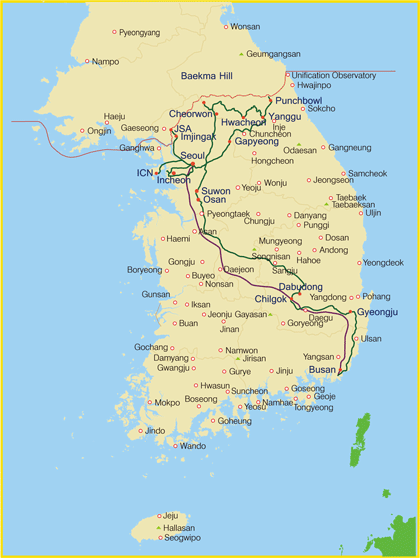 Day 1 Arrive Seoul (- - -)
60km
Day 1 Arrive Seoul (- - -)
60km
Touching down at Incheon International Airport places you in the heart of Korea. After you clear Passport and Customs control, you will be welcomed by the tour guide and then transferred to your hotel.
Day 2 Seoul (B)
Your exploration this morning begins with a visit to The War Memorial of Korea showcasing Korea's military history and providing a comprehensive overview of the Korean War. Outside of the museum on the hallway, names of fallen soldiers from the Korean War allies inscribed in large granite placards. Pay tribute to every soldier who made the ultimate sacrifice for the world peace. The memorial houses over 13,600 items in six halls under different themes: Memorial Hall, War History, Korean War, Expeditionary Forces Room, ROK Armed Forces Room, and Large Equipment Room. Each room is full of real and replica artifacts, dioramas, records and videos which are very interactive and easy to understand. This memorial is a good mix of outdoor exhibit that is one of the largest displays of military hardware. The Statue of Brothers that is based on the dramatic true story stands tall for all to see, reflecting the wish for peace and unification.
And then a driving tour of Seoul, featuring sites such as Seoul Plaza, City Hall, Cheonggye Square and pedestrian-friendly Gwanghwamun Plaza that is hemmed in on both sides by rushing traffic and office buildings. The plaza is lined on each side with 365m long streamlets, two centimeters deep and one meter across, the stone bed of the plaza's east side waterway engraved with important events in chronological order from 1392 to 2008.
Standing high on a stone pillar is a statue of Yi Sunsin who had engaged in twenty-three naval battles and emerged victorious in all of them during the Hideyoshi invasion (1592-1598). King Sejong who propagated the Korean alphabet in the 15th century is also honored with prominent statue. On August 16, 2014, Pope Francis celebrated Mass in this plaza to beatify 124 Korean martyrs. Near the southwest corner of the plaza is Korea's Kilometer Zero, marking the distances to 64 cities around the world, including Seoul's antipode, Montevideo, Uruguay, 19,606km.
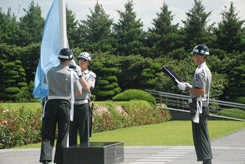
Step back in time to when life was gracefully slow and discover Gyeongbokgung Palace, a particularly charming spot that represents a colorful and turbulent side of the capital's 500-year history. Depending on timing, you may witness the Royal Guard Changing Ceremony featuring parade, password verification, duty shift and patrolling the gate. Accompanied by a court band with its colorful costumes and royal flags, the ceremony is performed daily basis at 10:00 and 14:00 except Tuesdays, although it is cancelled in case of rain or extremely hot or cold weather.
Up from the gates is a spacious stone-paved courtyard that is fully enclosed by wooden cloisters, and at the center of which runs three footpaths through two rows of rank stones, indicating the positions of the officials with the highest rank being closer to the hall.
Standing majestically on top of a two-tiered stone platform that is lined with detailed balustrades is Geunjeongjeon Hall, where the king formally granted audiences to his officials, gave declarations of national importance, presided over large official functions, and greeted foreign envoys and ambassadors. Check out the royal throne and a large painting, depicting sun, moon, five peaks, streams and pine trees, which was the crucial signifier of the king. And up in the center of the ceiling, the bright golden dragons in bold relief indicate the presence of the king.
At the back of the throne hall is a group of court offices. Displayed in front of the King's official quarters is sundial, conceived in order to catch the shadow of the sun, which tells time and 24 periods of seasonal change from the winter solstice to the summer solstice.
Sitting on the island in the rectangular lake is Gyeonghoeru. Supported by 48 square and cylindrical massive stone pillars representing the idea of Yin and Yang, this magnificent pavilion was used for many purposes ranging from receptions to national examinations.
Gangnyeongjeon is the king's sleeping and living quarters while Gyotaejeon is the queen's domain containing a number of halls. The noted feature of these main buildings is an absence of a top roof ridge.
Amisan Garden, landscaped with four hexagonal chimneys in orange bricks, is seldom noticed by the hurried visitors. Jagyeongjeon is the queen dowager's residence. Although less colorful, it is worth noting the wall, adorned with floral designs and the chimneys with ten longevity symbols.
Hyangwonjeong features a small pond with a manmade islet that supports a beautiful two-story pavilion. Behind this serene garden is Geoncheonggung, where the king and queen could relax in peace and quiet. It was here that the first electric lights in the country were installed in 1887 after 8 years of Thomas Edison's invention and a tragic chapter in Korea's history was recorded when empress Myeongseong was assassinated by the sword-bearing Japanese assassins in the early morning of 8 October 1895, allegedly under orders from Miura Goro.
Your visit to the National Folk Museum of Korea will familiarize you with wealthy culture of this friendly and picturesque nation. It is an excellent facility to illustrate the history of traditional life of the Korean people from the prehistoric age to the Joseon dynasty. The permanent exhibition features life and work, costumes and ornaments, handicrafts and technology, educations, living quarters, dietary life, oriental medicine, performing arts and games, beliefs and rituals, and
socio cultural life.
Insadong, at one time the center of traditional Korean art and antiques, features a mixture of historical and modern atmosphere representing the cultural glimpse of the nation. Clustered along the main street and alleys are lined with street vendors, wooden tea houses, restaurants and numerous galleries and shops dealing in antiques, oriental art supplies, and modern Korean art of all types and styles. Soak in the paintings, upscale artworks, antiques and potteries while you can. Get lucky and you just might meet the artist themselves. It can be plenty of fun walking on the main street, but you venture into the hidden alleys that do spring some unexpected surprises. While here, you may want to buy some souvenirs or simply wander and browse at leisure admiring cultural ambience.
Drive past Cheonggyecheon Stream. After the Korean War (1950-1953), more people migrated into Seoul to make their living and settled down along the stream in shabby makeshift houses. The accompanying trash and waste, and deteriorating conditions resulted in an eyesore for the city. The stream was covered with layers of concrete in the mid 1950s and roadway until the massive urban renewal project freed it in 2005. Today, a 5.8km creek tumbles gently through downtown Seoul, providing a much needed source of peace and relaxation for the citizens of this fast-paced city. You may have a chance to view the sculpture standing tall at the head of the stream on a small plaza. Created by Dutch artist Coosje Van Bruggen and Swedish artist Claes Oldenburg, a shell rising upward like pagoda symbolizes new life.
You will tour the centuries-old Namdaemun Market brimming with well over 11,000 shops selling anything you can imagine. One of the most colorful aspects of the market is an endless sprawl of street-vendor stalls that setup in the alleys and walkways between the buildings. The market is seriously crowded, so be prepared to get bumped around. A fantastic place to haggle over the price to get the best deal on something you want or simply admire the vibrancy of this massive market.
At the western entrance of the market in the middle of a traffic circle stands Sungnyemun. It is a formidable and iconic construct that served as the southern gate of the wall that surrounded Seoul during the period of the Joseon Dynasty.
Day 3 Seoul - Incheon - Seoul (B) 100km
Today, you will visit the historically significant sites of Incheon. In order to commemorate Incheon Landing Operation and share the story of peace, signs made of stone were installed at the Green, Blue, and Red Beaches. Stop at Wolmido getting glimpse of Green Beach where the first landing occurred. The high-risk Operation Chromite with 75,000 soldiers and 261 battleships was launched on September 15, 1950. The most spectacular amphibious landing in modern warfare led to the recapture of Seoul by the allied forces under the command of General Douglas MacArthur. Red Beach landing site marker stands on the roadside and can be viewed on the bus as the area is reclaimed today. Not far from the these two beaches is Blue Beach that is also now reclaimed.
While in Incheon, experience the heritage of the Chinese people as you stroll up the alleys of China Town which was once one of the largest and most dynamic commercial areas in the city, browse the handmade products and soak up the local culture. It is smaller in size now, but its Chinese characteristics and the aura of its heyday are still preserved. A short walk leads you to Jayu Gongwon, the Korea's first western style park built in 1888. On the park stands a statue of General MacArthur overlooking the beach where he came ashore.
Enjoy a walking tour of Modern History and Culture District, gaining intimate insights into the city's past.
Richly endowed with vestiges of Incheon's modern history, an endless array of building dating from the turn of the 19th century can be seen throughout this area, comparable to an open-air architecture museum. Open Port Museum has a rare collection of artifacts that represent Korea's modern history, most of which were all new to Korea at that time. Some of such examples are private elementary school, train, football, fire station, western hospital, electricity, hotel, telephone operator, ham, rubber shoes, tea house and soap, etc. Modern Architecture Museum showcasing some of the pictures of edifices exudes old charm. Although some of them are lost, there are British consulate, Chinese consulate, Japanese consulate, Russian consulate, Incheon Surveillance, Meteorological Observatory, and Incheon Mint. The cottage owned by Johnston who was the head of the Incheon maritime customs, and the cottage of H N Allen, who was a US minister to Korea, were among the significant landmarks of Incheon.
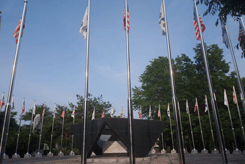
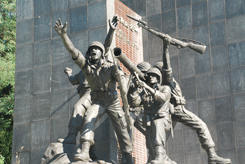
You cannot miss The Incheon Landing Operation Memorial Hall. The detailed and quite impressive Statue honoring the US forces that captured Incheon during the Korean War stands high. Near the statue is a bronze plaque in tribute of the 1st Marine Division that spearheaded the Incheon Landing Operation. The entrance to the memorial features a large archway adorned with the flags of the 16 countries that participated in the Korean War.
The first level of the memorial is to enter the museum. The museum is actually put together quite nicely with events of the Korean War and the Incheon Landing Operation presented in chronological order complete with explanations of the exhibits. Outdoor exhibition has a static display of aircraft and equipment used during the Korean War, most notably the landing crafts used during the invasion.
Day 4 Seoul - DMZ - Seoul (B) 140km
Please note that the DMZ is a politically sensitive area, and is therefore not always open to tourists.
In the event that the area cannot be visited, alternate sightseeing (Imjingak gondola and Odusan Observatory) will be arranged.
The 3rd Tunnel Tour
Rules and Regulations |
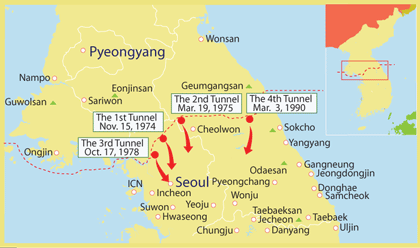 Imjingak is a park with an array of monuments and statues that speak to the Korean War (1950-1953), representing the wishes for unification and the pain the war caused to Korean people.
One such monument is Mangbaedan, a memorial site where displaced North Koreans pray for their ancestors. Near Mangbaedan is the Freedom Bridge, and was an important site where 12,773 prisoners of war returned to freedom. This short, sturdy wooden structure ends at a barricade, which embodies the North. The altar and the bridge now serve as places of remembrance for displaced families, and the millions of bright colored ribbons tied to the fence have messages of hope, dreams and wishes for unification between South and North Korea.
You can also see a derelict locomotive engine shot full of bullet holes and its bent wheels - not particularly special in any way other than it shows the destruction of war. Having been left in the DMZ since bombs derailed it during the Korean War; it was cleaned up and moved here in 2009. There is a collection of stones from 86 battlefields in 64 countries known as the Peace Stones that have witnessed suffering and grief of war. At nearby Memorial Park stands the Monument dedicated to United States Forces in the Korean War and the statue of Harry S. Truman.
Then, you board a bus to continue with other tourists on to the Demilitarized Zone which straddles the South and North Korean border. A 4km wide buffer of land stretches the breadth of the Korean peninsula. Before being allowed to enter the DMZ, you will have to obtain passport and security clearance at the Unification Bridge, the first control line with sentries and photo opportunities will be limited.
The 3rd tunnel is one of the four infiltration tunnels dug by the North to facilitate an invasion of the South. Discovered on October 17, 1978, it is a 1,635m long, 2m high and 2m wide, and could have accommodated 30,000 soldiers per hour in what was apparently designed for a surprise attack on Seoul. The tunnel runs through bedrock at a depth of about 73m below ground; 435m of which are found in the South over the Military Demarcation Line (MDL). It is designed at a three thousandth angle with northern side lower than southern side, so that water does not stagnate inside tunnel. After ducking and crouching your way 265m through the tunnel, you will reach one of the cement walls with iron door near the MDL that will prevent you from going any further north and where you peep through a small window at a barricade, just to see another barricade in the distance. You can clearly see the drill marks for dynamite all pointing toward the South. This finding, along with other clues, clearly affirmed their construction.
After exploring the tunnel, climb back out of the tunnel and make your way to the DMZ Exhibition Hall for a unique insight into the Korean War and model of soldiers digging the tunnel, equipment used by the North, model of Panmunjeom (Joint Security Area), a timeline of major North Korean provocations over the South since 1950, and photographs of the historical events about Korea's division. And time for a short video including old film that takes you back in time to the signing of the armistice and the creation of the DMZ.
Next stop is Dora Observatory. As you approach, you will see an eye catching slogan printed up on the wall "End of separation, beginning of unification". The observatory looks across the land north of Demilitarized Zone, the road and train track stretched side by side ahead into the North Korea,
bare mountains, treeless hills, watchtower, North Korean propaganda village and Gaeseong Industrial Complex. Financed and managed for the most part by South Korea, the project was launched in 2004 as a gauge of the volatile security situation on the peninsula, and South Korean companies could manufacture their products using North Korean labour. It once employed 803 South Korean and 54,764 North Korean workers, but this jointly run Industrial complex is totally shutdown as of February 10, 2016 in response to North Korea's nuclear test.
You will have a chance to stop at Tongilchon, a rural village located just 4 kilometers from the Military Demarcation Line. Established in the 1970s as part of a government initiative to support civilian settlement in this border area, the village is now primarily home to farmers.Today, Tongilchon has 174 households and 406 residents, making it the largest village within the Civilian Control Line.
Day 5 Seoul - Gapyeong - Punchbowl - Yanggu (B) 230km
As leisurely make your way to Yanggu, you will see Korea's fertile farmland, glistening brooks and lovely rice paddies that together forming a patchwork of colors and ever-changing textures of the rural Korean life. The United States of America was the first country which participated in the Korean War. The USA not only dispatched the largest scale of armed forces, but also suffered the largest sacrifice.
While in Gapyeong, pay a visit to the US forces monument. It is a very special place in their hearts for the men who fought with the 213th Armored Field Artillery Battalion. One portion of the monument features a book sculpted out of stone that tells the story of the battle in Korean and English.
The journey continues to Punchbowl, a natural geologic bowl several kilometers across, ringed by steep mountains on four sides. The bowl creates the richest farmland, and the area is starkly beautiful. Many fierce battles were fought here during the Korean War because of its strategic location. The Punchbowl was captured by the Korean People's Army (KPA) in the opening days of the Korean War. It was recaptured by UN forces in late September 1950 during the UN offensive that followed the Inchon landings and the breakout from the Pusan perimeter. UN Forces abandoned the region in mid-December 1950, during the withdrawal following the Chinese People's Volunteer Army intervention in the war. On 4 June 1951 the 1st Marine Division and the ROK 5th Infantry Division began to advance north of Inje towards the Punchbowl and the Hwacheon Reservoir. By 10 June the Marine/ROKA force had secured Kansan Line northeast of the Hwacheon Reservoir and the southern line of hills overlooking the Punch Bowl.
The Battle of Sosolsan (June 4 - 20, 1951): Korean Marine 1st Regiment, U.S. Marine 1st Division of 1st, 5th, 38th Regiment, 11th Artillery
The Battle of Daewoosan (July 8 - 31, 1951): Korean Marine 1st Regiment, U.S. 2nd Division of 23rd, 38th Regiment, Holland Unit
The Battle of Punch Bowl (August 3 - September 20, 1951): Korean Marine 1st Regiment, U.S. Marine 1st Division
The Battle of Bloody Ridge (August 18 - Sepetember 5, 1951): Korean Army 5th Division of 35, 36th Regiment, 3rd Division of 18, 22, 32 Regiment, 7th Division 8th Regiment, 8th Division of 27th Regiment, Marine 1st Regiment, U.S. 10th Corps, 2nd Division of the 9, 10, 22, 23, 38th Regiment, 72nd Tank Battalion of B Company, U.S. Marine 1st Division
The Battle of Baekseoksan (August 18 - October 28, 1951): Korean Army 7th Division of 3, 5, 8th Regiment, 16th Artillery Battalion, 8th Division, U.S. 96th Field Artillery Battalion
The Battle of Gachilbong (September 4 - October 14, 1951): Korean Army 5th Division
The Battle of Hartbreak (September 12 - October 15, 1951): 2nd Division of the 9, 23, 38th Regiment, 72nd Tank Battalion, 2nd Combat Engineer Battalion, French Unit, Holland Unit
The Battle of Hill 949 (November 17 - 18, 1951): Korean Army 6th Divsion, 8th Division of 21st Regiment
The Battle of Christmas Hill (December 25 - 28, 1951): Korean Army 7th Division
You will tour the
Eulji Observatory and the 4th Tunnel. At the peak of the observatory, 1000 meters above sea level, enjoy the stunning 360 panorama of the Punch Bowl, including an ominous view of North Korea. Then, explore one of four known tunnels passing under the DMZ, dug secretly by the North. and check out a vivid hint of the surprise attack and to carry out future military operations against the South. Persons who suffer from claustrophobia, heart conditions or asthmatic symptoms are not allowed to enter the tunnel.
Day 6 Yanggu - Hwacheon - Cheorwon (B) 120km
En route at at Peace Dam that measures 125m high and 601m long. It was built to stave off possible catastrophic flooding should the upstream Imnam Dam in North Korea collapse, either intentionally or by accident. The dam was completed in 2005. As it stands, the dam has no reservoir, and is merely preventive. See World Peace Bell that was made from empty cartridge cases gathered from the world’s conflict zones in that it carries a significant meaning. The bell weights 37.5 ton but is incomplete. Check out a broken pigeon wing that is on display near the bell. It will be added bringing the bell complete on the day of day of unification of Korea.
Cheorwon was one of the Iron Triangle of the Korean War along with Gimhwa and Pyeonggang. Today, you will experience significant military presence and learn about the stark reality and immense tragedy of divided Korea. Being so close to the border, both towns are still very much a slow and rural.
They are less-traveled locations where you may not have the comforts and conveniences of luxury travel. Tour Baegmagoji Hill - the bloodiest area of the Korean War, during one 10-day offensive, ownership of the hill switched 24 times. A monument stands tall there honoring the soldiers who lost their lives in the battle to defend the hill and Baegma Museum speaks to the battle with bazooka guns, ammunition, and other items used at the time.
Then, check out the ruins of a Russian style structure - Labor Party Office Building standing alone in the middle of the empty Cheorwon lava plateau. A three-story, non-iron concrete building was completed in 1946 was used by the North Koreans to promote communist politics and control people until the outbreak of the Korean War. This is a locale where they committed numerous brutal attacks and killed many people. The traces of the history remaining in the building include many bullet holes on the back of this building, sickles, wires, and human bones. You will never miss a Kilometer Zero marker, a clear evidence of the town center.
Next, join the escorted tour of The 2nd Tunnel and a number of sites evocative of Korean War memories. Discovered in March 1975 about 13km north of Cheorwon, a 3.5km long tunnel runs through bedrock at a depth of 50 - 160m below ground, 1.1km of which are found in the south over the Military Demarcation Line. The tunnel is large enough to move heavy weapons such as tanks, field artillery and armored personnel carriers. Persons who suffer from claustrophobia, heart conditions or asthmatic symptoms are not allowed to enter the tunnel.
At Peace Observatory, you can see into ultra-secretive North Korea.
Pyeonggang plateau and the Propaganda village, as well as Kim Il-sung Hill and Baldy Ridges. The DMZ, which has been restricted from any civilian access for more than half century, symbolizes the heartbreak of the divided Korean people, but has been a boon to the natural ecosystem. Thus, it became home to many wild species like black bears, mule deer, wild boars, wild geese, eagles, Chinese egrets, Manchurian cranes, black-faced spoonbills and swan geese, to name a few.
As you drive along, you will witness Weoljeongri Railroad Station. It is the defunct last stop on the line that once ran from the South into what is now North Korea and the bombed remains of a train last used more than 60 years ago stand as a symbol of the broken state of inter-Korean relations.
Day 7 Cheorwon - Suwon (B) 140km
With leisurely time to pack, travel to Suwon and tour the UNESCO World Heritage of Hwaseong Fortress from the 18th century. Though it is relatively small in scale, it is well acknowledged as the best structure of its kind ever built in Korea. A 5.74km-long fortress enclosing both flatland and hilly terrain is parapeted with crenels and merlons and highlighted by four main gates and well over 50 structures including temporary palace where the king sought refuge during war and found rest during times of peace. A walk through the whole fortress could take several hours but it is well worth making a short walking tour to enjoy the splendor of the fortress, including the Korea's largest Janganmun Gate.
Day 8 Suwon - Osan - Dabudong - Chilgok - Gyeongju (B) 360km
There will be a lot of driving today. The Battle of Osan on July 5, 1950, is remembered primarily for being the first encounter between North Korean and American military forces (Task Force Smith) during the Korean War. At 0816 the first American artillery fire of the Korean War hurtled through the air toward the North Korean tanks. The number two howitzer fired the first two rounds, and the other pieces then joined in the firing. But the tanks kept on coming, undeterred by the exploding artillery shells. Task Force Smith was not able to use any antitack mines-one of the most effective methods of defense against tanks-as there were none in Korea at the time. After the last of the tank column had passed through the infantry position and the artillery and tank fire back toward Osan had subsided, the American positions became quiet again. About 1430, Colonel Smith decided that if any of his command was to get out, the time to move was at hand. The Battle has much to teach modern generations - certainly about bravery and duty under adverse circumstance, but also about military preparedness and the training and employment of American military forces.
Visit Cheonpyeongri, where ROK and US army first launched joint operation, followed by Dabudong War Memorial. Surrounded by Yuhaksan and Gasan, with the Nakdong River running through the area, Chilgok is where the Dabudong Battle, the bloodest battle in the Korean War, took place in 1950. Patriots & Peace memorial is also included in the tour. The Jakosan or Hill 303 massacre was a war crime that took place during the opening days of the Korean War on August 17, 1950, on a hill above Waegwan, South Korea. Forty-one United States Army (US) prisoners of war were shot and killed by troops of the North Korean People's Army (NKPA) during one of the numerous smaller engagements of the Battle of Pusan Perimeter. During the 55-day Battle of Dabudong, the NKPA suffered casualties of 24,000 dead, wounded or missing, while the ROK and US defenders lost over 10,000 killed, wounded or missing.
The three invading NKPA divisions were badly mauled sustaining a fatal defeat.
With time to learn about the devastation of war, continue to Gyeongju, an ancient capital of the Silla dynasty (BC57-AD935), often dubbed as Museum without Walls. Today, you are in one of the ten most historically significant sites in the world with ancient temples, weathered stone pagodas, royal tombs, Buddhist bas-reliefs, and fortress ruins.
Day 9 Gyeongju (B)
With a full day to further explore the delights of UNESCO World Heritage Site, Seokguram grotto. It is the home of the serene stone Buddha of the eighth century. Inside, a white statue of a seated Buddha in a sublime state of enlightenment, is surrounded by 37 relief figures of Bodhisattvas, disciples, devas, and guardian kings. The grotto represents the magnificent harmony of religion, science and the arts of Buddhism, symbolizing the pure land in which Buddha resides.
A short ride leads you to another UNESCO World Heritage Site, Bulguksa temple, where you will witness the impressive gates, symbolic bridges leading up to the world of Buddha, graceful architectures, Three-storied Seokgatap and highly ornate Dabotap blending well into the architectural harmony.
At Gwaneumjeon hall, check out the image of the Avalokitesvara who is referred to as the Bodhisattva of Compassion and has a thousand hands, and eyes in each so as to reach out to those in need of help. You will see a gilded statue of Vairocana with the gesture of the first wisdom, Sakyamuni Buddha attended by two bodhisattvas along with sixteen figures of Buddha's disciples sitting in deep meditation, and a gilt-bronze Amitabha Buddha, the ruler of the Western Paradise Sukhavati. The architectural design of Bulguksa is one of constrained dignity, peace, and harmony and the temple still remains one of the most remarkable achievements of the ancient Far East.
The Gyeongju Historic Areas contain a remarkable concentration of outstanding examples of Korean Buddhist art, in the form of sculptures, reliefs, pagodas, and the remains of temples and palaces from the flowering, in particular between the 7th and 10th centuries, of this form of unique artistic expression.
Visit Gyeongju National Museum.The first thing that you will notice is The Bell of King Seongdeok, the largest extant bell in Korea. You must certainly stand in awe before the bell from the 8th century with such artistic beauty of design. The bell is distinguished not only for its outstanding beauty but also for its long reverberating sound, the incredibly precise casting technique, in addition to the sad legend surrounding it. On entering the museum, you will marvel at the priceless archaeological and historical artifacts including splendid gold crowns, earrings, belts, ornaments, glassware, potteries, and clay figures as well as a royal barge.
Continue your historic discovery by exploring Donggung palace and Wolji pond, a pleasure garden built to commemorate the victory of Silla, and the world's oldest existing astronomical observatory, Cheomseongdae. Finally Tumuli Park that encompasses 23 huge burial mounds. You can go inside Cheonmachong and see how the tombs were made and replicas of the treasures excavated in 1973.
Day 10 Gyeongju - Busan (B) 110km
Travel to Busan, a Korea's second largest city surrounded by the ocean on one side, and mountains on the other. Its deep harbor and gentle tides have allowed it to grow into the largest port in Korea and the fifth largest in the world. It is also a center of industry and commerce, a thriving metropolis formed unusually long in shape along its coastal line.
Visit UN memorial cemetery where 2,339 deceased soldiers from fourteen Korean War allies rest in honored serenity. Learn about the Korean War and pay tribute to those who dedicated their lives to the World Peace. During the period of 1951-1954, remains of approximately 11,000 fallen of the UN Forces were buried here. Thereafter, most were repatriated to their home countries. In the cemetery, lie the remains of Korean War heroes from Australia(281), Belgium(1), Canada(382), Colombia(4), France(47), Netherlands(124), New Zealand(32), Norway(1), Republic of Korea(39), South Africa(11), Thailand(1), Turkiye(462), United Kingdom(892), United States of America(41) Unknown and others(16).
You will tour the Gamcheon culture village, an amazing community built on the side of a hill. Once a poverty-stricken village, it has been spruced up with colorful houses, cafes, murals, galleries and arts shops, sculptures, and scenic views. The atmosphere feels more fun, creative and quirky, less commercial and mercenary. The attraction weaves in and out of back alleys where people still live. It is out of the way, but relatively easy to get to. The artistic vibes in the village in light of its history makes it a culturally distinctive place in an urban city. You can take winding alleys and stairs that form a maze around and through and freely walk up and down hills taking in the views and the culture.
Then explore a fascinating Jagalchi fish market, a great attraction located dockside. Here you will find a diverse array of seafood on display as you walk along the narrow alleys of street vendors. A nearby indoor market features live fish in the tanks and the upstairs are dried fish along with many restaurants selling raw fish at reasonable prices. The market is really a visual and culinary treat.
Enjoy the vibrant ambience as you leisurely make your way to the Gwangbokro Street, full of shops selling everything from bargains to luxury items. Adjacent is a maze of small streets alive with color, sidewalks sprinkled with unique shops and local eateries. There is a BIFF square, Busan’s modern movie district having hand prints of the famous movie stars and directors on the sidewalk, movie theaters, trendy shops and street food stalls. The area with originally little more than a pair of cinemas that were built over half a century ago had turned into the newly transformed district, and was named BIFF Square on August 14, 1996.
Day 11 Busan - Seoul (B) 450km
With leisurely time to pack, enjoy a pleasant two and half hours journey on a speed train across the picturesque countryside to Seoul. The balance of the day at own pursuit. You can explore the city yourself or look for souvenirs.
Day 12 Departure (B) 60km
After this wonderful trip tracking the footsteps of Korean War Heroes and with time to reflect the moving experience of visiting the battlefields, you will return to the airport in time for your flight. By boarding, you are already high above Incheon heading for home.
